User Tagging
Automatically adds user tags to content in Sonarr and Radarr, making it easy to track which users requested which content.
Quick Setup
- Navigate to Utilities → User Tagging
- Enable tagging for Sonarr and/or Radarr
- Configure tag prefix (default: "pulsarr-user")
- Set tag removal behavior (keep, remove, or prefix)
- Click Sync Tags Now to apply tags to all content
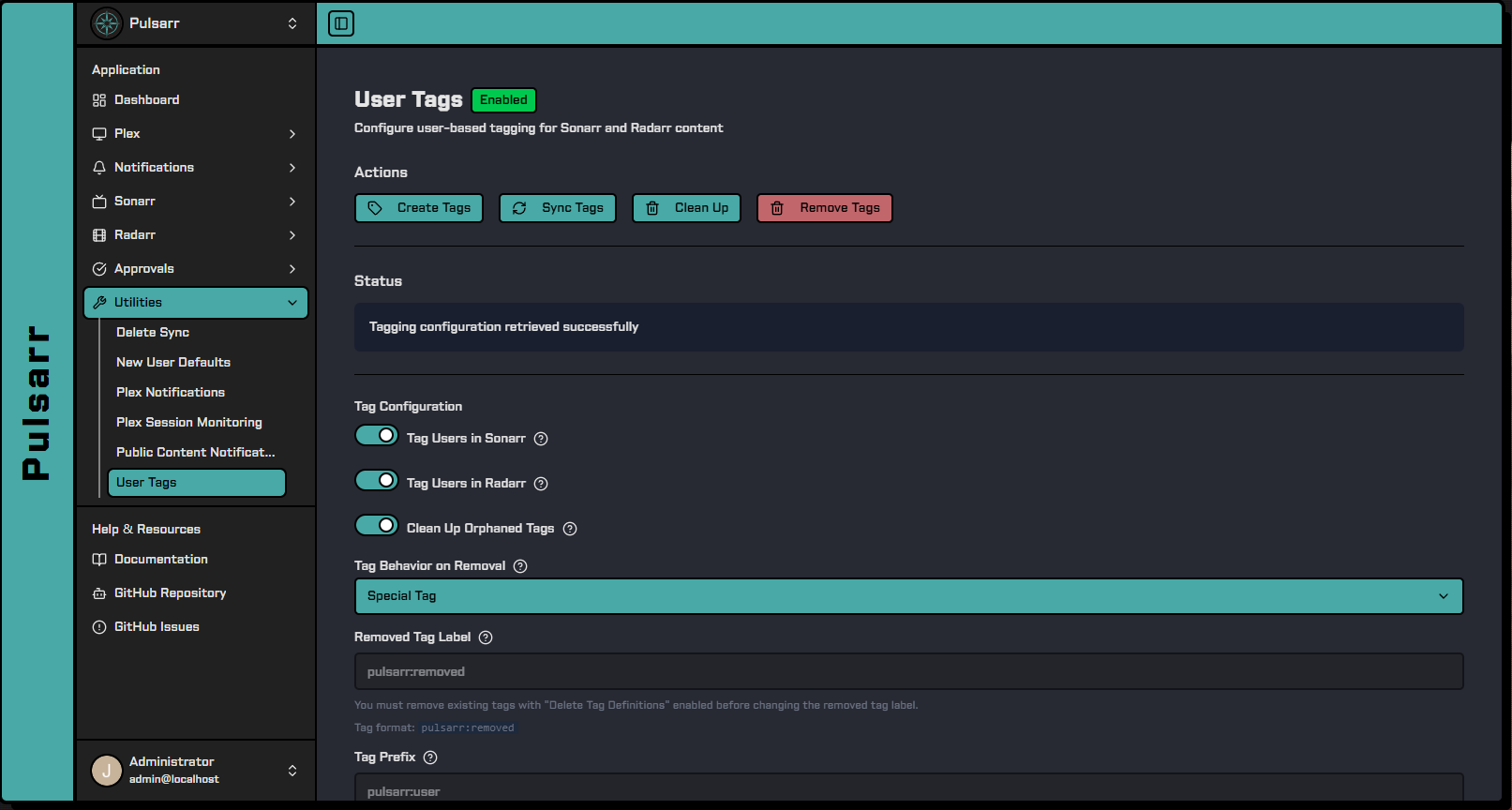
Configuration
| Setting | Description |
|---|---|
| Enable Tagging | Toggle for Sonarr and Radarr instances |
| Tag Prefix | Customize prefix for user tags (default: "pulsarr-user") |
| Tag Removal Mode | Keep, Remove, or Prefix existing tags |
| Removal Prefix | Custom prefix for removed content tags |
| Clean Up Orphaned Tags | Auto-remove tags for deleted users |
Manual Actions
| Action | Description |
|---|---|
| Create Tags | Create tag definitions in Sonarr/Radarr |
| Sync Tags | Apply tags to all existing content |
| Clean Up | Remove orphaned tags for deleted users |
| Remove Tags | Remove all Pulsarr user tags (destructive) |
Tag Removal Modes
| Mode | Behavior | Best For |
|---|---|---|
| Keep | Preserves tags for historical tracking | Accountability, analytics |
| Remove | Deletes tags when content leaves watchlists | Active library management |
| Prefix | Adds prefix (e.g., "removed:") to existing tags | Deletion workflows with history |
Delete Sync Integration
User Tagging integrates with Delete Sync's tag-based mode. Use removal tags to trigger automated deletion workflows while preserving tag history.
Best Practices
- Use descriptive tag prefixes to avoid conflicts with existing tags
- Enable "Clean Up Orphaned Tags" to maintain tag hygiene
- Consider "Prefix Mode" for deletion workflows requiring historical tracking
- Sync tags regularly to keep Sonarr/Radarr updated
Troubleshooting
| Problem | Solution |
|---|---|
| Tags not appearing | Verify tagging enabled; check content added via Pulsarr; run manual sync |
| Orphaned tags accumulating | Enable cleanup option; run manual cleanup; review tag prefix |
API Reference
See the User Tags API documentation for detailed endpoint information.